Showing posts with label marathon. Show all posts
Showing posts with label marathon. Show all posts
Tuesday, May 5, 2020
Glass
It's crowded behind the starting line
but the people around her take some of the chill off the morning air
She stands in shorts and a jog bra,
gloves and arm warmers,
a band around her head keeping her ears warm
minutes before the start
She goes into her routine
Kneels and checks the snugness of her shoes
Makes sure the laces are securely tied
At this point she always notices how
from knee high
The runners at a marathon are like a forest of legs
So many sinewy legs
So many miles
So many stories
She checks the fit of her shorts, her top
Then pulls the insulin pump from her waistband
She sees her blood sugar number on its touch screen
And a graph indicating whether it is rising or falling
She smiles at the technology helping her today
It hasn't always been this way
Her first syringe was made of glass.
She didn't like shots, but adjusted fast
A pediatric nurse told her Mom to be proud
then, very serious, but not very loud
"She's a brave little girl, but she may not last"
Fifty-five years on
she’s about to run
she’s about to run
yet another marathon
comfortable in the crowd at the starting line


Thursday, October 24, 2019
99 Marthons and Ultras
Craig Stubing and I talked this past weekend about when my 100th lifetime
marathon/ultra would be, and I was vague as usual. After that I was
looking at my records in the Marathon Maniacs database and noticed I
hadn't entered the Skyline to the Sea Clambake 50K, so I put it in there
and added to my personal spreadsheet.
So both of these lists
have 99 entries on them now. If you go by that number, the Chino Hills
50K on November 9 will be number 100.
But 5 of those 99 maybe shouldn't count.
1.
Skyline to the Sea was a fun run, no entry fee, no official place or
time. They even made us chant "This is not a race" at the start of the
run.
2. I ran the Big Sur Marathon as part of a relay team.
Both my brother Chris and I started at the starting line and continued
through the whole course. It was a good run, but officially we ran the
relay, not the marathon.
3. I was a DNF at the Pikes Peak Marathon in 2018. I ran the full distance, but not fast enough to be an official finisher.
4
and 5. In 2014 I ran the Majestic Marathon and the Fathers Day Marathon
in Long Beach. There's no reason these two shouldn't count except for
arbitrary Marathon Maniacs rules requiring 15 entrants and 10 finishers.
So I have 94 official Marathon Maniacs finishes.
You could easily say it's really 96.
If you want to be really generous and loose it's 99.Maybe I'll have 100 be the Chino Hills 50K, or maybe I'll have it land on the Salmon Falls 50K.
Tuesday, February 5, 2019
Approaching 100
Please comment below and suggest events for my 100th race of marathon length or longer.
My official Marathon Maniacs count is currently 89, 76 marathons and 13 ultras.
Thank you.
I have a lot of events I should write something about, but I've been lacking inspiration.
These are the long races I've done since the last one I wrote about on this blog, Dances With Dirt, July 8, 2017:
2/3/2019 Surf City Marathon
1/12/2019 Avalon 50 Mile
12/1/2018 Death Valley Trail Marathon
10/27/2018 Lake Hodges 50K
10/7/2018 Long Beach Marathon
9/15/2018 Flagstaff Marathon
8/19/2018 Pikes Peak Marathon*
7/28/2018 Harding Hustle 50K
6/16/2018 Holcomb Valley Trail Run 33 mile
6/9/2018 Shadow of the Giants 50K
3/18/2018 LA Marathon
3/10/2018 Catalina Island Marathon
12/3/2017 California International Marathon
11/5/2017 Santa Clarita Marathon
10/7/2017 St. George Marathon
7/22/2017 Harding Hustle 50K
I had a DNF/unofficial finish at Pikes Peak, where I ran the distance but came in too late to count. That race is not counted in the 89 I mentioned above.
I have 5 more long races I am registered for this year. I expect to add more, and I expect to hit 100 sometime in 2020.
My official Marathon Maniacs count is currently 89, 76 marathons and 13 ultras.
Thank you.
I have a lot of events I should write something about, but I've been lacking inspiration.
These are the long races I've done since the last one I wrote about on this blog, Dances With Dirt, July 8, 2017:
2/3/2019 Surf City Marathon
1/12/2019 Avalon 50 Mile
12/1/2018 Death Valley Trail Marathon
10/27/2018 Lake Hodges 50K
10/7/2018 Long Beach Marathon
9/15/2018 Flagstaff Marathon
8/19/2018 Pikes Peak Marathon*
7/28/2018 Harding Hustle 50K
6/16/2018 Holcomb Valley Trail Run 33 mile
6/9/2018 Shadow of the Giants 50K
3/18/2018 LA Marathon
3/10/2018 Catalina Island Marathon
12/3/2017 California International Marathon
11/5/2017 Santa Clarita Marathon
10/7/2017 St. George Marathon
7/22/2017 Harding Hustle 50K
I had a DNF/unofficial finish at Pikes Peak, where I ran the distance but came in too late to count. That race is not counted in the 89 I mentioned above.
I have 5 more long races I am registered for this year. I expect to add more, and I expect to hit 100 sometime in 2020.
Monday, April 24, 2017
Hello, Is this thing on?
First post on this blog in almost 5 years. I'm not sure who will notice this. The main reason I'm posting here is I'd like to write a little about an upcoming event, the St. George Marathon, and leave it here and link to it from Twitter and Facebook.
Type One Run has a few members going to the 2017 St. George Marathon, October 7, and is asking other interested runners with type 1 diabetes to register and run it with us.
If you buy a nice Type One Run running shirt, it will help us all make a good showing and represent people with diabetes. You can only get in on this order of shirts until 4/28/2017.
In the time since I last posted here, four and a half years, I ran 16 more marathons. Sadly, they were all terribly slow, mostly because I haven't trained properly.
Here are the details:
-->
That number between the date and the state in my spreadsheet is "days between", as in days between marathons. Since as you can see, the last marathon was February of 2016, and I'm not registered for another until July, the next "days between" number will be the highest ever. I've gone more than a year without running a marathon.
But just in time I've gotten inspired by this great group, Type One Run. I was incredibly fortunate to meet Craig Stubing, founder of Type One Run, at a JDRF Summit in Pasadena. We spoke briefly about running and the fact that Type One Run had a team in the Ragnar SoCal Relay.
Then a week later, I got an email saying that one of their runners had dropped out, and asking if I would like to join. Of course I would!
I've had this experience of being on an overnight relay with a team of diabetics four times now, and I would recommend it to anyone dealing with this disease.
My experience with Type One Run was relentlessly positive and inspiring. And it reminded me of a lot of things I've been missing in my life recently.
OK. A couple of things to explain in that list of marathons:
The Catalina Eco Marathon is just really, really tough, especially for a fat old, out of shape diabetic.
 I did the Bataan Death March Marathon for my second time in 2014, but this time my youngest brother Chris did it with me, and we did it in the "Heavy" category, meaning we wore 35 pound backpacks. That is also a tough marathon, even without a pack, but not quite like Catalina Eco.
Type One Run has a few members going to the 2017 St. George Marathon, October 7, and is asking other interested runners with type 1 diabetes to register and run it with us.
If you buy a nice Type One Run running shirt, it will help us all make a good showing and represent people with diabetes. You can only get in on this order of shirts until 4/28/2017.
In the time since I last posted here, four and a half years, I ran 16 more marathons. Sadly, they were all terribly slow, mostly because I haven't trained properly.
Here are the details:
-->
| 6:37:19 | 15:10 | 2/7/2016 | 126 | CA | Surf City Marathon |
| 5:22:53 | 12:20 | 10/4/2015 | 154 | MN | Medtronic Twin Cities Marathon |
| 5:21:36 | 12:17 | 5/3/2015 | 64 | CA | OC Marathon |
| 6:29:49 | 12:35 | 2/28/2015 | 27 | CA | Orange Curtain 50K |
| 5:06:01 | 11:41 | 2/1/2015 | 85 | CA | Surf City Marathon |
| 7:46:08 | 17:47 | 11/8/2014 | 27 | CA | Catalina Island Eco Marathon |
| 5:26:18 | 12:27 | 10/12/2014 | 35 | CA | Long Beach Marathon |
| 5:49:38 | 13:21 | 9/7/2014 | 84 | CA | Ventura Marathon |
| 5:51:10 | 13:25 | 6/15/2014 | 42 | CA | Fathers Day Marathon* |
| 5:30:51 | 12:38 | 5/4/2014 | 44 | CA | OC Marathon |
| 9:01:21 | 20:39 | 3/23/2014 | 35 | NM | Bataan Death March Marathon |
| 5:27:15 | 12:30 | 2/16/2014 | 28 | CA | Majestic Marathon* |
| 5:37:11 | 12:52 | 1/19/2014 | 133 | CA | Carlsbad Marathon |
| 5:35:07 | 12:47 | 9/8/2013 | 224 | CA | Ventura Marathon |
| 5:55:57 | 13:35 | 1/27/2013 | 77 | CA | Carlsbad Marathon |
| 6:06:03 | 13:59 | 11/11/2012 | 294 | CA | Malibu Marathon |
That number between the date and the state in my spreadsheet is "days between", as in days between marathons. Since as you can see, the last marathon was February of 2016, and I'm not registered for another until July, the next "days between" number will be the highest ever. I've gone more than a year without running a marathon.
But just in time I've gotten inspired by this great group, Type One Run. I was incredibly fortunate to meet Craig Stubing, founder of Type One Run, at a JDRF Summit in Pasadena. We spoke briefly about running and the fact that Type One Run had a team in the Ragnar SoCal Relay.
Then a week later, I got an email saying that one of their runners had dropped out, and asking if I would like to join. Of course I would!
I've had this experience of being on an overnight relay with a team of diabetics four times now, and I would recommend it to anyone dealing with this disease.
My experience with Type One Run was relentlessly positive and inspiring. And it reminded me of a lot of things I've been missing in my life recently.
OK. A couple of things to explain in that list of marathons:
The Catalina Eco Marathon is just really, really tough, especially for a fat old, out of shape diabetic.

Thursday, September 13, 2012
Diabetic Running Gear
Hey, reader,
I've been doing a bit of running lately, but not enough. When I get out there, I'm having fun, so I'm confident that I'll be able to build up some more mileage before meeting up with the Insulindependence crowd at the Carlsbad Marathon, which is the next event in which I'm sure I'll participate.
But today I'm just going to share a report on the diabetes gear I take with me on runs.
Glucose tablets, or some source of quick carbohydrates:
Some ID, indicating that you are diabetic:
A meter:
A meter is so much smaller than so many less important things people run with, there's really no excuse for not carrying one except if you're not going far. The little piece of cloth is for those few times when it might be necessary to dry your fingers to get a test.
An infusion site:
An insulin pump:
My DexCom sensor and transmitter:
My DexCom receiver:
Then of course there are all of the ordinary runner things, a watch, maybe some Gu, some water...
It does take some organization sometimes to get out the door.
.
I've been doing a bit of running lately, but not enough. When I get out there, I'm having fun, so I'm confident that I'll be able to build up some more mileage before meeting up with the Insulindependence crowd at the Carlsbad Marathon, which is the next event in which I'm sure I'll participate.
But today I'm just going to share a report on the diabetes gear I take with me on runs.
Glucose tablets, or some source of quick carbohydrates:
 |
| These are the store brand glucose tablets. Glucolift makes a tastier, all-natural alternative, but this is what I have right now. |
 |
| This is my MedicAlert ID. I started with the MedicAlert Foundation in 1974, so I'm not going to change now. |
 | |
| OneTouch Ultra Mini meter, lancet device, a few strips in an old Listerine Strips container, a piece of tech fiber cloth (like ShamWow) and plastic bag to hold it all. |
An infusion site:
 |
| What a fat model I had pose for these pictures, huh? |
 |
| My Animas Ping. |
 |
| That's the back of my arm near my shoulder. |
 |
| It's in an iPhone arm band wrapped around my forearm. I can see my blood sugar trend as easily as the time on my watch. |
It does take some organization sometimes to get out the door.
.
Friday, May 11, 2012
A Shrine to Me
OK, bear with me. I'm a little embarrased about this, but not so embarrassed that I'm not publishing it to the World Wide Web.
I'm moving, so that means packing stuff up, taking stock of what I need and what I don't need, what's clutter, and what's important.
One of the things that hit me during this process is that I have a buttload of medals, trophies, t-shirts, and other assorted race junk. I know there are charities that will take your old medals and give them to someone else who deserves and will appreciate them. Well, that's fine if that's what you want to do, but it doesn't feel right for me.
Maybe I'm too much of a packrat. Anyway, the medals and trophies mean something to me. If someone else has earned a medal, I'd rather buy them one than give them one of mine.
I've given away only one medal, and that was one that had a special meaning to me. I gave it to someone for whom I think it will have a special meaning.
But that's just what makes sense to me, not something I'm trying to convince anyone else of.
What this means is that I have a bunch of race junk. Which gets us to the embarrassing part. In one of our spare bedrooms, I had built up what kind of seemed like a shrine to me when I started packing it up.
Here are 5 medals from the Silicon Valley Marathon.
 Next to that I had decorated a steer skull with 5 medals from the Tucson Marathon and a bunch of leather-strapped ceramic medals from the Big Sur Marathon and Marathon Relay.
 When you walk around race expos, you see companies selling various methods for displaying your medals. These are often something a little like a small set of coathooks, six to twelve hooks or pegs to hang your medals on. That works fine if you only run a few races.
I would need about a dozen of those.
I got this great idea to use a four-by-six-foot sheet of pegboard and a box of pegs like you might use in a workshop.


 I'm not going to get into the other stuff here, trophies, cups, plaques, etc. The medals filled a small box, a about the size of a four-slice toaster, that I put into a large plastic tote, which I then filled with the other stuff, using race shirts to protect the fragile stuff.
Yeah, I'm going to have to think about what it says about me before I open that tote and rebuild the shrine.
.
I'm moving, so that means packing stuff up, taking stock of what I need and what I don't need, what's clutter, and what's important.
One of the things that hit me during this process is that I have a buttload of medals, trophies, t-shirts, and other assorted race junk. I know there are charities that will take your old medals and give them to someone else who deserves and will appreciate them. Well, that's fine if that's what you want to do, but it doesn't feel right for me.
Maybe I'm too much of a packrat. Anyway, the medals and trophies mean something to me. If someone else has earned a medal, I'd rather buy them one than give them one of mine.
I've given away only one medal, and that was one that had a special meaning to me. I gave it to someone for whom I think it will have a special meaning.
But that's just what makes sense to me, not something I'm trying to convince anyone else of.
What this means is that I have a bunch of race junk. Which gets us to the embarrassing part. In one of our spare bedrooms, I had built up what kind of seemed like a shrine to me when I started packing it up.
Here are 5 medals from the Silicon Valley Marathon.


I would need about a dozen of those.
I got this great idea to use a four-by-six-foot sheet of pegboard and a box of pegs like you might use in a workshop.


Yeah, I'm going to have to think about what it says about me before I open that tote and rebuild the shrine.
.
Saturday, October 15, 2011
Bad-Assedness
I wrote this a few days ago in the "Diabetics Who Run Marathons" group on TuDiabetes. It occurs to me that it might be OK for a blog post, and I'm not writing much else. So here it is.
So... I've been thinking about the headline "Stunts to Impress" in Higdon's advice on multiple marathons, and the much appreciated comments on me being "BADASS" and "amazing."
Of course I'm often looking for opportunities in the conversation here to brag about things I've done. I like to be called bad-ass. And I don't see anything wrong with that. Some of the greatest achievements of mankind have been done so someone could say the equivalent of "Look, Ma! No hands!"
A good part of people doing this is that it expands the realm of possibilities for others.
In that spirit I feel like I should point out that I know a type 1 diabetic who's run about twice as many marathons as I have, and run them faster.
I've met two diabetics who have gotten the silver buckle at the Western States 100 mile endurance run, and I'm aware of at least one other whom I haven't met. You get the silver buckle for finishing in less than 24 hours. There are probably others I'm not aware of.
There is a type 1 diabetic world class marathon and ultra marathon runner.
I could go on. I guess the point is that while I like being called "BADASS" and that's at least part of why I do some of the things I do, I'm aware that there are others more bad-ass than I am.
And 14 years ago I was a diabetic runner afraid to try a marathon. I was inspired and comforted by reading about or meeting other diabetic athletes, and not just the fantastic athletic ones, but the ordinary folks like me.
Wherever you're at with diabetes and exercise, there are people ahead of you and behind you on the bad-ass scale. Well, since everyone is different, and every life situation is different, there really isn't a scale we can all be measured against.
We are all inspiring each other.
Reading back over this, I kind of rambled. I hope I had something to say.
"Stunts to Impress" aren't necessarily a bad thing.
In other news, along with a contingent of runners from Glucomotive, I ran the Denver Rock 'N' Roll Marathon last Sunday.

So... I've been thinking about the headline "Stunts to Impress" in Higdon's advice on multiple marathons, and the much appreciated comments on me being "BADASS" and "amazing."
Of course I'm often looking for opportunities in the conversation here to brag about things I've done. I like to be called bad-ass. And I don't see anything wrong with that. Some of the greatest achievements of mankind have been done so someone could say the equivalent of "Look, Ma! No hands!"
A good part of people doing this is that it expands the realm of possibilities for others.
In that spirit I feel like I should point out that I know a type 1 diabetic who's run about twice as many marathons as I have, and run them faster.
I've met two diabetics who have gotten the silver buckle at the Western States 100 mile endurance run, and I'm aware of at least one other whom I haven't met. You get the silver buckle for finishing in less than 24 hours. There are probably others I'm not aware of.
There is a type 1 diabetic world class marathon and ultra marathon runner.
I could go on. I guess the point is that while I like being called "BADASS" and that's at least part of why I do some of the things I do, I'm aware that there are others more bad-ass than I am.
And 14 years ago I was a diabetic runner afraid to try a marathon. I was inspired and comforted by reading about or meeting other diabetic athletes, and not just the fantastic athletic ones, but the ordinary folks like me.
Wherever you're at with diabetes and exercise, there are people ahead of you and behind you on the bad-ass scale. Well, since everyone is different, and every life situation is different, there really isn't a scale we can all be measured against.
We are all inspiring each other.
Reading back over this, I kind of rambled. I hope I had something to say.
"Stunts to Impress" aren't necessarily a bad thing.
In other news, along with a contingent of runners from Glucomotive, I ran the Denver Rock 'N' Roll Marathon last Sunday.

Tuesday, May 17, 2011
St. George Experience
You may find a couple of things about this blog post remarkable. First, it may seem like I've written a longer post for just the swim portion of an Ironman than anyone would expect if I had done the whole thing. Second, it may seem like a long, whiny list of excuses.
Well, that all may be true. But I see it as an explanation. Basically, I was again at the start of an Ironman race without having once done an Ironman distance swim in the required time. This time, I know I was a good enough swimmer that I could have made it if all conditions were perfect. No one should ever expect all conditions to be perfect, should they?
Conditions were actually excellent in several ways for this swim. The weather outside of the water was great. There was no wind to speak of at the reservoir, so the water was nice and smooth.
It was cold, but it was never so cold that it bothered me much. I had earplugs and a neoprene hood, so I may have been better off than others. I never got the shivers after getting out, as I did in 2009. The water temperature wasn't a factor except for the fact that it was cold enough for me to wear a wetsuit, which is a huge benefit. I can't complain about that.
But I did have some problems. None of these would have been enough to keep me from making it in time if I was better than a marginal swimmer. And I am to blame for not being a better swimmer. Like the last time, I worked very hard on it, but I started too late.
Next time, and there will be a next time, I swear I will have the swim in the bag.
I got up at 3 AM and my blood sugar was in good shape. I drank and bolused for a Banana Cream Ensure Muscle Health. Then I walked over to my Triabetes teammate, Brian's room and gave him back his Dexcom charger, which he had generously allowed me to borrow because I'd forgotten to bring mine. We were both staying at the Motel 6 next door to Denny's. I went over to Denny's and got toast and a huge cup of coffee to go. I thought I bolused right for that as well.
By a quarter to 5, on the bus out to Sand Hollow Lake, my Dexcom was saying my blood sugar was over 300, and I test at 281, so I took a big bolus to bring it down, thinking that it was probably rising because of nerves, and I wasn't likely to get any more relaxed as the start approached.
When we got to the lake, I went straight through the transition area to the porta-johns. After that, I went to get water to fill the bottles on my bike, and then I figured I would take a look at my blood sugar again.
That's when I notice my Dexcom receiver was gone. It had fallen out of my pocket.
I frantically retraced my steps. I asked volunteers at one of the changing tents if there was a place for lost and found items, and they sent me to the other changing tent. The volunteers there didn't know anything about a lost and found, but said I should go to the other end of the transition area and talk to the guy with the microphone. Over there, no one knew anything about a lost and found, but one volunteer said that I was the third person to ask about it.
So I went back to tracing my steps, and I could just barely see my Dexcom leaning against the base of one of the porta-johns, just sitting there waiting for me to come back.
Of course it had been out of range for a while, so it didn't provide any information, and I had started thinking about how much time I had left to get my wet suit on and get ready for the swim start.
 I went over to the start, got my wetsuit on, and did one last blood sugar test. It was 127. I had set aside three energy gels for the swim, but I had to eat one right away, knowing that my blood sugar was on a downward trend. I had been hoping to start the swim with my blood sugar a little high, so the exercise could bring it down safely, but clearly I had over-estimated the effect that starting line stress was going to have on me.
There was supposed to be a table to drop off things like prescription lenses. I wanted to drop off my glucose meter. The problem was that there was not a drop off at water entry and a pick up at water exit. There was only one table, at water exit.
This simply meant that I had check my blood sugar, run over to water exit, then get back into the massive lineup at water entry. I don't know how someone who actually required prescription lenses to get around was supposed to drop off those prescription lenses and navigate back to water entry.
The one good thing about that was that I was lucky enough to run into my Mom, who came with me to St. George for support. She came in on the spectator shuttle, and the timing was perfect as she was headed toward the shoreline while I was going back to the start. It was nice to get a hug from her.
There was a very narrow gap, a single lane dirt road, down to the water entrance, with about 1500 people backed up behind it. With the pro start at 6:45 AM, there was only 15 minutes for all of these people, mostly barefoot, of course, to squeeze through the narrow space, get out into the water, and swim to the start.
It didn't help to have someone on the PA system telling us over and over that we had to get into the water. There simply was not enough time to get all of the swimmers through a narrow opening down to the water and out to the start.
I was up to my shins when the gun went off, and there were still many people behind me.
When I got deep enough to start swimming, my goggles started to fill with water. I hadn't pressed them down tightly onto my face to create a water-tight seal yet. I had to stop swimming, pull my goggles loose enough to shake out the water, and press them back on. Fortunately, it worked perfectly first try, and I didn't have any more problems with them.
Within a few yards of swimming, I hit the upper branches of a submerged tree. I looked around to see if it was another swimmer before I figured out what it was. Many of us swam over this tree. It would have been nice if the branches near the surface could have been trimmed off.
From where I was at start time, it wasn't at all clear where the start was, so I went off in the wrong direction.

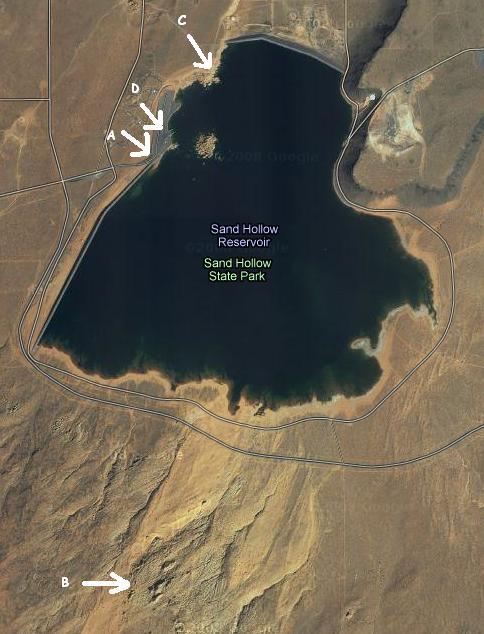
I don't think the diagram of the swim course was accurate. This might have been helpful. The diagram made it look like the start was right at the shoreline. It wasn't. It made it look like the first long straightaway of the swim went parallel to the shore. I don't think it did. I think it actually angled away from the shore.
If you look at the aerial photo below, you see some rocks pointed to at B at the bottom. The first long line of buoys actually ran straight from about the island toward those rocks, not the direction indicated by the diagram.
The start was not at the shoreline, but many yards out from A. I don't know how far, because I never knew exactly where the start was. We should have swam toward the island, then turned right, to the south. I didn't know where to go, so I started going parallel to shore long before I got out far enough. When I realized I was alone, I looked up and saw some people swimming diagonally away from shore, and others swimming perpendicular to shore.
I yelled and yelled at boats and kayaks I saw. I mostly loudly yelled, "Which way?!"
I was definitely down at this point, with the thought filling my mind that it was already over. I had to fight it off and tell myself to just keep trying. I wasn't going to give up.

I kept trying to guess which way I should be going, and swim in that general direction. After a while, someone finally did answer me and put me on the right track, but it didn't seem like anyone was trying to do that in the critical first 200 to 300 yards.
After I got on the course, I could see I wasn't alone. There were others who were going to be close to the cutoff time. There was one guy in particular who was doing a lot of breast stroke. I would pass him while he was doing that, then he would pass me when he switched to freestyle again.
At the first left turn, I saw someone getting out of the water onto a boat. I could sympathize, but I thought I was going to be fine. I was doing much better than I have in any long open water swim in the past.
I had already noticed that I was having a hard time swimming a straight line. I needed to sight out ahead frequently.
When I got to the second left, turning northward, I grabbed the buoy and took a look at my watch. I knew I was more than a mile into the swim, and it was 56 minutes since the start, so I was doing all right. But I had to keep pushing to make it.
Sometime after the first quarter of that long northward straight, a woman on a surfboard came alongside me while I was resting for a second, to ask if I needed help. I pulled one of the power gels out of my wet suit, sucked it down and handed her the wrapper.
She stuck near me for a while, and I decided I may as well sight on her if she was going my way. I asked her if she would stick with me and if I could sight on her, and she said it was fine. I'm sure it helped some, and I'm sure that at times she was too close to me, and I got an unfair drafting advantage, but it didn't go as well as I would have hoped.
Very soon she was crowding me on the left side, and I assumed that I must have been going too far to the left, so I steered right. After a while she told me, "You're going too far to the right."
If I had gone to the left more, I would have hit her surfboard.
I should have known then that she and I had different ideas about how this should work. I should have told her, "Just go in a straight line parallel to the buoys, and I will try to stay parallel to you."
Instead, I was never sure if she was getting closer or farther away simply because she wasn't going in a straight line.
After I had kept my head down and sighted only on her for several hundred yards, then looked up, I saw I was way out to the right of the line of buoys, and I said, "I'm way off course!"
She said, "You're fine. Do you want to swim closer to the buoys?"
"Yes!"
But I still didn't explain to her what I wanted. I didn't want to complain, and I thought that it was obvious. But the obvious thing was that she didn't know what I expected.
We approached the last turn, which, rather than being way out in the lake as indicated in the diagram, was very close to the point marked as C in the photograph. I was unsure if I was just tired, or low, so I ate my last power gel.
I was afraid to swim past the turn buoy, so I made several unnecessary stops as I got closer. When I finally made the turn, I had a hard time seeing the finish. When I finally saw the line of buoys ahead of me, I lined myself up, put my head down, and started swimming. The volunteer on the surfboard started yelling at me after only a few strokes, "You're going too far to the right!"
So I stopped and looked up. I was still in a perfect line with the buoys. So she didn't correct me when I was going a long way off line, but was yelling at me when I was still in line.
They told me I had twenty minutes. So I put my head down and tried to swim as consistently as I could. The surfboard kept me from going too far to the right, which is always my problem. When I finally took another sighting, they told me I had ten minutes left.
I wasted a few seconds toward the end. I almost hit the boat dock. Someone warned me at the last moment, and instead of crashing head first, I put my hand on the end of the dock. I took the biggest gulp of lake water I'd had all day and coughed it out.
I started back to the boat ramp, and the water was so clear, I could see the concrete underneath me. It looked shallow enough to walk, so I stopped swimming and put my feet down, but I couldn't reach the ramp. I swam on, and when I was sure I was in shallow water, I did the same thing, with the same result. So I swam some more, and put my feet down, and just barely touched ground.
Then I walked up the ramp to some disappointed looking race officials.
I reached the end of the swim about 2 minutes too late to continue. I know that if I had been a better swimmer, little things wouldn't matter, and I would have finished in time. There's no reason why I should have expected everything to go perfectly.
It was a good thing I had the gels during the swim, since I tested at 109 shortly after the finish.
Here's the Dexcom graph from the swim, starting at 7 AM and ending at 9:22 AM. The gap is where I lost my Dexcom receiver in the transition area for a while.

I ate one gel at about 6:30. As I said, my meter said 127, but the Dexcom said 174. When I tested at 109 at the end, my Dexcom said 177.
So my Dexcom was consistently higher than my actual blood sugar. My Dexcom graph shows a low of 143 during the swim, so my blood sugar was probably close to going low.
Anyway, that was it. I was a spectator again for most of the day.
I went to the motel pool toward the end of the day, for a symbolic swim. I just wanted to make a statement to myself that I wasn't beaten, I would keep working until I made it.
It was of course a very small pool, so it took about three strokes to cross it diagonally, from one corner to the other.
Someone at the pool asked me if I had done the Ironman that day. I knew I still had the number "52" painted on my leg, buy I didn't want to explain. I just said, "No."
.
Well, that all may be true. But I see it as an explanation. Basically, I was again at the start of an Ironman race without having once done an Ironman distance swim in the required time. This time, I know I was a good enough swimmer that I could have made it if all conditions were perfect. No one should ever expect all conditions to be perfect, should they?
Conditions were actually excellent in several ways for this swim. The weather outside of the water was great. There was no wind to speak of at the reservoir, so the water was nice and smooth.
It was cold, but it was never so cold that it bothered me much. I had earplugs and a neoprene hood, so I may have been better off than others. I never got the shivers after getting out, as I did in 2009. The water temperature wasn't a factor except for the fact that it was cold enough for me to wear a wetsuit, which is a huge benefit. I can't complain about that.
But I did have some problems. None of these would have been enough to keep me from making it in time if I was better than a marginal swimmer. And I am to blame for not being a better swimmer. Like the last time, I worked very hard on it, but I started too late.
Next time, and there will be a next time, I swear I will have the swim in the bag.
I got up at 3 AM and my blood sugar was in good shape. I drank and bolused for a Banana Cream Ensure Muscle Health. Then I walked over to my Triabetes teammate, Brian's room and gave him back his Dexcom charger, which he had generously allowed me to borrow because I'd forgotten to bring mine. We were both staying at the Motel 6 next door to Denny's. I went over to Denny's and got toast and a huge cup of coffee to go. I thought I bolused right for that as well.
By a quarter to 5, on the bus out to Sand Hollow Lake, my Dexcom was saying my blood sugar was over 300, and I test at 281, so I took a big bolus to bring it down, thinking that it was probably rising because of nerves, and I wasn't likely to get any more relaxed as the start approached.
When we got to the lake, I went straight through the transition area to the porta-johns. After that, I went to get water to fill the bottles on my bike, and then I figured I would take a look at my blood sugar again.
That's when I notice my Dexcom receiver was gone. It had fallen out of my pocket.
I frantically retraced my steps. I asked volunteers at one of the changing tents if there was a place for lost and found items, and they sent me to the other changing tent. The volunteers there didn't know anything about a lost and found, but said I should go to the other end of the transition area and talk to the guy with the microphone. Over there, no one knew anything about a lost and found, but one volunteer said that I was the third person to ask about it.
So I went back to tracing my steps, and I could just barely see my Dexcom leaning against the base of one of the porta-johns, just sitting there waiting for me to come back.
Of course it had been out of range for a while, so it didn't provide any information, and I had started thinking about how much time I had left to get my wet suit on and get ready for the swim start.

There was supposed to be a table to drop off things like prescription lenses. I wanted to drop off my glucose meter. The problem was that there was not a drop off at water entry and a pick up at water exit. There was only one table, at water exit.
This simply meant that I had check my blood sugar, run over to water exit, then get back into the massive lineup at water entry. I don't know how someone who actually required prescription lenses to get around was supposed to drop off those prescription lenses and navigate back to water entry.
The one good thing about that was that I was lucky enough to run into my Mom, who came with me to St. George for support. She came in on the spectator shuttle, and the timing was perfect as she was headed toward the shoreline while I was going back to the start. It was nice to get a hug from her.
There was a very narrow gap, a single lane dirt road, down to the water entrance, with about 1500 people backed up behind it. With the pro start at 6:45 AM, there was only 15 minutes for all of these people, mostly barefoot, of course, to squeeze through the narrow space, get out into the water, and swim to the start.
It didn't help to have someone on the PA system telling us over and over that we had to get into the water. There simply was not enough time to get all of the swimmers through a narrow opening down to the water and out to the start.
I was up to my shins when the gun went off, and there were still many people behind me.
When I got deep enough to start swimming, my goggles started to fill with water. I hadn't pressed them down tightly onto my face to create a water-tight seal yet. I had to stop swimming, pull my goggles loose enough to shake out the water, and press them back on. Fortunately, it worked perfectly first try, and I didn't have any more problems with them.
Within a few yards of swimming, I hit the upper branches of a submerged tree. I looked around to see if it was another swimmer before I figured out what it was. Many of us swam over this tree. It would have been nice if the branches near the surface could have been trimmed off.
From where I was at start time, it wasn't at all clear where the start was, so I went off in the wrong direction.

I don't think the diagram of the swim course was accurate. This might have been helpful. The diagram made it look like the start was right at the shoreline. It wasn't. It made it look like the first long straightaway of the swim went parallel to the shore. I don't think it did. I think it actually angled away from the shore.
If you look at the aerial photo below, you see some rocks pointed to at B at the bottom. The first long line of buoys actually ran straight from about the island toward those rocks, not the direction indicated by the diagram.
The start was not at the shoreline, but many yards out from A. I don't know how far, because I never knew exactly where the start was. We should have swam toward the island, then turned right, to the south. I didn't know where to go, so I started going parallel to shore long before I got out far enough. When I realized I was alone, I looked up and saw some people swimming diagonally away from shore, and others swimming perpendicular to shore.
I yelled and yelled at boats and kayaks I saw. I mostly loudly yelled, "Which way?!"
I was definitely down at this point, with the thought filling my mind that it was already over. I had to fight it off and tell myself to just keep trying. I wasn't going to give up.
I kept trying to guess which way I should be going, and swim in that general direction. After a while, someone finally did answer me and put me on the right track, but it didn't seem like anyone was trying to do that in the critical first 200 to 300 yards.
After I got on the course, I could see I wasn't alone. There were others who were going to be close to the cutoff time. There was one guy in particular who was doing a lot of breast stroke. I would pass him while he was doing that, then he would pass me when he switched to freestyle again.
At the first left turn, I saw someone getting out of the water onto a boat. I could sympathize, but I thought I was going to be fine. I was doing much better than I have in any long open water swim in the past.
I had already noticed that I was having a hard time swimming a straight line. I needed to sight out ahead frequently.
When I got to the second left, turning northward, I grabbed the buoy and took a look at my watch. I knew I was more than a mile into the swim, and it was 56 minutes since the start, so I was doing all right. But I had to keep pushing to make it.
Sometime after the first quarter of that long northward straight, a woman on a surfboard came alongside me while I was resting for a second, to ask if I needed help. I pulled one of the power gels out of my wet suit, sucked it down and handed her the wrapper.
She stuck near me for a while, and I decided I may as well sight on her if she was going my way. I asked her if she would stick with me and if I could sight on her, and she said it was fine. I'm sure it helped some, and I'm sure that at times she was too close to me, and I got an unfair drafting advantage, but it didn't go as well as I would have hoped.
Very soon she was crowding me on the left side, and I assumed that I must have been going too far to the left, so I steered right. After a while she told me, "You're going too far to the right."
If I had gone to the left more, I would have hit her surfboard.
I should have known then that she and I had different ideas about how this should work. I should have told her, "Just go in a straight line parallel to the buoys, and I will try to stay parallel to you."
Instead, I was never sure if she was getting closer or farther away simply because she wasn't going in a straight line.
After I had kept my head down and sighted only on her for several hundred yards, then looked up, I saw I was way out to the right of the line of buoys, and I said, "I'm way off course!"
She said, "You're fine. Do you want to swim closer to the buoys?"
"Yes!"
But I still didn't explain to her what I wanted. I didn't want to complain, and I thought that it was obvious. But the obvious thing was that she didn't know what I expected.
We approached the last turn, which, rather than being way out in the lake as indicated in the diagram, was very close to the point marked as C in the photograph. I was unsure if I was just tired, or low, so I ate my last power gel.
I was afraid to swim past the turn buoy, so I made several unnecessary stops as I got closer. When I finally made the turn, I had a hard time seeing the finish. When I finally saw the line of buoys ahead of me, I lined myself up, put my head down, and started swimming. The volunteer on the surfboard started yelling at me after only a few strokes, "You're going too far to the right!"
So I stopped and looked up. I was still in a perfect line with the buoys. So she didn't correct me when I was going a long way off line, but was yelling at me when I was still in line.
They told me I had twenty minutes. So I put my head down and tried to swim as consistently as I could. The surfboard kept me from going too far to the right, which is always my problem. When I finally took another sighting, they told me I had ten minutes left.
I wasted a few seconds toward the end. I almost hit the boat dock. Someone warned me at the last moment, and instead of crashing head first, I put my hand on the end of the dock. I took the biggest gulp of lake water I'd had all day and coughed it out.
I started back to the boat ramp, and the water was so clear, I could see the concrete underneath me. It looked shallow enough to walk, so I stopped swimming and put my feet down, but I couldn't reach the ramp. I swam on, and when I was sure I was in shallow water, I did the same thing, with the same result. So I swam some more, and put my feet down, and just barely touched ground.
Then I walked up the ramp to some disappointed looking race officials.
I reached the end of the swim about 2 minutes too late to continue. I know that if I had been a better swimmer, little things wouldn't matter, and I would have finished in time. There's no reason why I should have expected everything to go perfectly.
It was a good thing I had the gels during the swim, since I tested at 109 shortly after the finish.
Here's the Dexcom graph from the swim, starting at 7 AM and ending at 9:22 AM. The gap is where I lost my Dexcom receiver in the transition area for a while.

I ate one gel at about 6:30. As I said, my meter said 127, but the Dexcom said 174. When I tested at 109 at the end, my Dexcom said 177.
So my Dexcom was consistently higher than my actual blood sugar. My Dexcom graph shows a low of 143 during the swim, so my blood sugar was probably close to going low.
Anyway, that was it. I was a spectator again for most of the day.
I went to the motel pool toward the end of the day, for a symbolic swim. I just wanted to make a statement to myself that I wasn't beaten, I would keep working until I made it.
It was of course a very small pool, so it took about three strokes to cross it diagonally, from one corner to the other.
Someone at the pool asked me if I had done the Ironman that day. I knew I still had the number "52" painted on my leg, buy I didn't want to explain. I just said, "No."
.
Tuesday, February 22, 2011
Wearing the D Gear
What seems like many years ago I read about Bill King running marathons with a glucose meter strapped on his wrist. I tried a few ways to do that myself, but it seemed like more hassle than it was worth. It's really not easy to insert a strip, get a drop of blood, and touch it to the strip, all pretty much using one hand. It's more convenient to carry the meter elsewhere, like a SPIbelt, and take it out when you need it.
But at Ironman Arizona in 2009, I saw Bill Carlson with a Dexcom receiver in a plastic bag duct-taped to his forearm. That looked convenient, but painful to remove. Bill had his current blood sugar trend at the touch of a button, right there like a wrist watch.
So I've given some thought, and done some experiments, in that direction.
My first thoughts went toward sleeve-like things, cheap garments from a thrift store, cut-off tube socks or sleeves with some modification to hold the Dexcom.
I had this idea that all I really needed to do was to wrap the Dexcom in plastic wrap. Then I thought, well, just wrap it all the way around my arm. It's actually difficult to wrap my arm and the Dexcom together that way, though, and it would become a sweaty mess very quickly.
I had used stretch bandage that comes in rolls, one brand is called Co-Band, to attach some things to my bike before. It's the stuff they wrap your elbow in when you give blood. It seemed like this might work for this purpose also.
So here's something that seemed to work, the Dexcom receiver wrapped in plastic wrap with lots of plastic hanging off the ends, then the ends wrapped onto my arm using stretch bandage material.

This seems to hang on well enough while biking. I haven't tried it on a run yet. I'll probably go back to the sleeve idea, since it would save a lot of time in the swim to bike transition to have something I could just pull on, instead of wrapping my arm. I can't see fitting my wetsuit over this, even if I wanted to.
.
But at Ironman Arizona in 2009, I saw Bill Carlson with a Dexcom receiver in a plastic bag duct-taped to his forearm. That looked convenient, but painful to remove. Bill had his current blood sugar trend at the touch of a button, right there like a wrist watch.
So I've given some thought, and done some experiments, in that direction.
My first thoughts went toward sleeve-like things, cheap garments from a thrift store, cut-off tube socks or sleeves with some modification to hold the Dexcom.
I had this idea that all I really needed to do was to wrap the Dexcom in plastic wrap. Then I thought, well, just wrap it all the way around my arm. It's actually difficult to wrap my arm and the Dexcom together that way, though, and it would become a sweaty mess very quickly.
I had used stretch bandage that comes in rolls, one brand is called Co-Band, to attach some things to my bike before. It's the stuff they wrap your elbow in when you give blood. It seemed like this might work for this purpose also.
So here's something that seemed to work, the Dexcom receiver wrapped in plastic wrap with lots of plastic hanging off the ends, then the ends wrapped onto my arm using stretch bandage material.

This seems to hang on well enough while biking. I haven't tried it on a run yet. I'll probably go back to the sleeve idea, since it would save a lot of time in the swim to bike transition to have something I could just pull on, instead of wrapping my arm. I can't see fitting my wetsuit over this, even if I wanted to.
.
Friday, February 18, 2011
Things I should have posted about
As a race, the Carlsbad Marathon on January 23rd went as well as I could expect. That means awful. But it was still a great experience. It was a huge Glucomotive event, and my brother Jon was also there to enjoy the festivities and support the race.
I had close to zero training, so I figured I had to be conservative. I thought 4:30 would be a remotely possible time goal, so I aimed for 10 minute miles.
I saw Gary Schmidt and Emily Iannello at the start and ran with them for a bit. I also met Ed Ettinghausen, who is going for the world record for marathons in one year.
He isn't keeping his stats up to date, but you can get an idea of what Ed's doing by looking at his stats on the Marathon Maniacs site.
Anyway, I ran OK to about 17 miles. It was clear well before that that I wasn't going to last, but at a big steep hill along the beach, at the last turnaround, I really came apart.
I slowed way down for about a mile. Realizing I was just trudging along, I started walking. Several times I tried to start running again, and it just seemed too hard. Then at about 20 miles, right before the marathon course hooked back up with the half course, I started running again and felt fine. At least fine enough to just jog through it.
I ran for a couple of miles, then came across some Glucomotive folks doing the half, Jim Collins and Ashley Ernst, who was one of the "Heroes of the Marathon", and Ashley's friend. I have to apologize for not remembering her name.
Jim was having cramp problems, so they were all helping each other along, walking and jogging as possible.
With a little over 3 miles to go, we got to the Glucomotive group of volunteers, where my brother Jon was with his girlfriend, Gina.
I asked them if they wanted to walk to the finish with me, and they did.
So I walked it off.
I had about a 20 mile run, and a lot of walking on the day. It was not a good race, but as I said, it was a great day.
In general, my new Animas Ping insulin pump is working great. I swim with it frequently. I just stick it in the side of my suit with the clip sticking out and the pump against my skin.
There are some little annoyances, but the same could be said for Medtronic pump I was using before. I wish I could take the good points from each and put them together. It all seems like common sense to me, the things I don't like, but I'm sure there are some patents that are keeping it from being as good as it could be.
For example, the Animas pump will calculate the bolus for me, then just display it. It's then up to me to enter how much I want to bolus. There's no way to just say, "Give me what you just calculated that I need, you stupid machine."
Then entering an amount to bolus is ridiculous. You can click up or down 0.05 units per button press, or you can hold down the button and it will start to roll by increasing amounts. You know how this goes. It's a similar to the Medtronic pumps. It's actually a pretty common interface, for setting digital clocks, thermostats, etc.
With Medtronic, it's easier to get used to. Animas is fricking crazy. It seems to go 0.05, 0.10, 0.15, 0.50, 1,5, 3.5, 5, 8, ... not moving at all, then moving way way too fast. And the kicker is it doesn't stop when you take your finger off the button, so if you take your finger off at 5, it will probably stop at 6.5. Entering carbs is about the same.
So you either click up one step at a time or go way over then back down too far, then over, then under, getting closer and closer to what you want to enter. It's terrible. And I can't believe they could have failed to see this in usability testing.
Maybe I'll get used to it, but if I do, it will take a while, and I will be getting used to something that's more difficult than it has to be.
Changing the reservoir is harder on the Animas, but inserting an infusion site is easier. The Animas pump times out frequently, rapidly, while changing the reservoir. And when it times out, it goes back to the Home screen, so you have to click back into the Prime/Rewind screen. Crazy and annoying.
The woman who trained me on the Animas said that I'll eventually be able to change the reservoir and an infusion site without it timing out. After changing everything out several times, I doubt it. It would take the kind of skill required of Marines who can disassemble and reassemble an M16 blindfolded in 60 seconds.
The only way I've been able to get close, and still not avoid a time out, is to put in the new site and fill up a new reservoir, having everything ready before rewinding. It's not user friendly. It's unfriendly.
Still, I'm getting comfortable with the new pump, and as I said, it's great for swimming.
The Dexcom CGM is just incredible. I know my A1c is going to be down at my next checkup. I can't help it. Being able to see what is going on with my blood sugar all the time means I am fixing problems I wasn't even aware of before.
.
I had close to zero training, so I figured I had to be conservative. I thought 4:30 would be a remotely possible time goal, so I aimed for 10 minute miles.
I saw Gary Schmidt and Emily Iannello at the start and ran with them for a bit. I also met Ed Ettinghausen, who is going for the world record for marathons in one year.
He isn't keeping his stats up to date, but you can get an idea of what Ed's doing by looking at his stats on the Marathon Maniacs site.
Anyway, I ran OK to about 17 miles. It was clear well before that that I wasn't going to last, but at a big steep hill along the beach, at the last turnaround, I really came apart.
I slowed way down for about a mile. Realizing I was just trudging along, I started walking. Several times I tried to start running again, and it just seemed too hard. Then at about 20 miles, right before the marathon course hooked back up with the half course, I started running again and felt fine. At least fine enough to just jog through it.
I ran for a couple of miles, then came across some Glucomotive folks doing the half, Jim Collins and Ashley Ernst, who was one of the "Heroes of the Marathon", and Ashley's friend. I have to apologize for not remembering her name.
Jim was having cramp problems, so they were all helping each other along, walking and jogging as possible.
With a little over 3 miles to go, we got to the Glucomotive group of volunteers, where my brother Jon was with his girlfriend, Gina.
I asked them if they wanted to walk to the finish with me, and they did.
So I walked it off.
I had about a 20 mile run, and a lot of walking on the day. It was not a good race, but as I said, it was a great day.
In general, my new Animas Ping insulin pump is working great. I swim with it frequently. I just stick it in the side of my suit with the clip sticking out and the pump against my skin.
There are some little annoyances, but the same could be said for Medtronic pump I was using before. I wish I could take the good points from each and put them together. It all seems like common sense to me, the things I don't like, but I'm sure there are some patents that are keeping it from being as good as it could be.
For example, the Animas pump will calculate the bolus for me, then just display it. It's then up to me to enter how much I want to bolus. There's no way to just say, "Give me what you just calculated that I need, you stupid machine."
Then entering an amount to bolus is ridiculous. You can click up or down 0.05 units per button press, or you can hold down the button and it will start to roll by increasing amounts. You know how this goes. It's a similar to the Medtronic pumps. It's actually a pretty common interface, for setting digital clocks, thermostats, etc.
With Medtronic, it's easier to get used to. Animas is fricking crazy. It seems to go 0.05, 0.10, 0.15, 0.50, 1,5, 3.5, 5, 8, ... not moving at all, then moving way way too fast. And the kicker is it doesn't stop when you take your finger off the button, so if you take your finger off at 5, it will probably stop at 6.5. Entering carbs is about the same.
So you either click up one step at a time or go way over then back down too far, then over, then under, getting closer and closer to what you want to enter. It's terrible. And I can't believe they could have failed to see this in usability testing.
Maybe I'll get used to it, but if I do, it will take a while, and I will be getting used to something that's more difficult than it has to be.
Changing the reservoir is harder on the Animas, but inserting an infusion site is easier. The Animas pump times out frequently, rapidly, while changing the reservoir. And when it times out, it goes back to the Home screen, so you have to click back into the Prime/Rewind screen. Crazy and annoying.
The woman who trained me on the Animas said that I'll eventually be able to change the reservoir and an infusion site without it timing out. After changing everything out several times, I doubt it. It would take the kind of skill required of Marines who can disassemble and reassemble an M16 blindfolded in 60 seconds.
The only way I've been able to get close, and still not avoid a time out, is to put in the new site and fill up a new reservoir, having everything ready before rewinding. It's not user friendly. It's unfriendly.
Still, I'm getting comfortable with the new pump, and as I said, it's great for swimming.
The Dexcom CGM is just incredible. I know my A1c is going to be down at my next checkup. I can't help it. Being able to see what is going on with my blood sugar all the time means I am fixing problems I wasn't even aware of before.
.
Wednesday, February 18, 2009
Lost Weekend
OK, So I did that. The Pemberton Trail 50K on Saturday and the Lost Dutchman Marathon on Sunday.
And I wasn't alone. At least four of my fellow Marathon Maniacs did both events, and my friend, Melissa, who was not even registered for Lost Dutchman until the afternoon after running Pemberton, ran the whole race with me Sunday.
Melissa has now proudly joined the ranks of the Marathon Maniacs, and she does it at the exalted Iridium level, a level it took me two and a half years to achieve. Awesome.
 Pemberton Trail 50K
Believe it or not, the hardest of the two days for me was Saturday. I started out thinking that two weeks off from marathons was enough recovery time for me to run well for the 50K. After all, it isn't a tough course for a trail run, and the trail should have been easier on these old joints.
As it turns out, I'm not as tough as I thought I was. I wasn't fully recovered from three marathons in the previous four weeks. I felt pretty tired after the first few miles.
I hit the wall hard after 17 or 18 miles.
Pemberton is a two lap course, and there's a rough, rocky section about two miles out from the start. The first time through was a breeze, actually kind of fun. The second time through I was just trying to keep my feet under me and not fall down.
There were less than 150 of us running this race, so I spent a lot of time running alone through the desert. This Haiku came to me as I covered the desolate miles on my aching legs:
when the race day comes
it doesn't help to regret
the workouts you missed
Something to remember every day during training. Sitting here now typing this up, I'm thinking along these lines:
easy to register
for unknown levels of pain
far in the future
With about 10 miles to go, I started walking every significant uphill. I was thinking ahead to Lost Dutchman, and I was unsure about being able to run it at all if I didn't try to conserve energy.
 Lost Dutchman Marathon
Lost Dutchman is a fun race with lots of little things to make it interesting. That's why Runners World named it one of the Best Little Marathons, or something like that.
We got bussed out into the desert, under the weird rock formations at the base of the Superstition Mountains, where we warmed ourselves sitting around presto logs, waiting for the start.
The main difference between this start and Pemberton was that I had dreams of running well on Saturday. Sunday morning, those illusions were gone. I knew I just had to keep making forward progress, so that was my only goal.
And that turned out to be remarkably easy, if painful.
I wore my Marathon Maniacs shirt, which I hardly ever do, simply because I have so many other commitments and affiliations. But it's always good to get cheers from fellow Maniacs and comments from other marathoners when I do wear the yellow singlet. It was a good choice for a race that was going to take a long time and require a lot of encouragement.
Of course, as is usually the case, we saw a lot of the same people over and over again all day, and we made some new friends. Melissa was happy to tell anyone who would listen that we had run 50K the day before, and many people became fans.
There were no blood sugar issues either day. I checked three times during the 50K, and I was always above 120 and below 170. I went totally by feel through the marathon (by feel and experience) and was at 91 after the finish.
And I wasn't alone. At least four of my fellow Marathon Maniacs did both events, and my friend, Melissa, who was not even registered for Lost Dutchman until the afternoon after running Pemberton, ran the whole race with me Sunday.
Melissa has now proudly joined the ranks of the Marathon Maniacs, and she does it at the exalted Iridium level, a level it took me two and a half years to achieve. Awesome.
 Pemberton Trail 50K
Believe it or not, the hardest of the two days for me was Saturday. I started out thinking that two weeks off from marathons was enough recovery time for me to run well for the 50K. After all, it isn't a tough course for a trail run, and the trail should have been easier on these old joints.
As it turns out, I'm not as tough as I thought I was. I wasn't fully recovered from three marathons in the previous four weeks. I felt pretty tired after the first few miles.
I hit the wall hard after 17 or 18 miles.
Pemberton is a two lap course, and there's a rough, rocky section about two miles out from the start. The first time through was a breeze, actually kind of fun. The second time through I was just trying to keep my feet under me and not fall down.
There were less than 150 of us running this race, so I spent a lot of time running alone through the desert. This Haiku came to me as I covered the desolate miles on my aching legs:
when the race day comes
it doesn't help to regret
the workouts you missed
Something to remember every day during training. Sitting here now typing this up, I'm thinking along these lines:
easy to register
for unknown levels of pain
far in the future
With about 10 miles to go, I started walking every significant uphill. I was thinking ahead to Lost Dutchman, and I was unsure about being able to run it at all if I didn't try to conserve energy.
 Lost Dutchman Marathon
Lost Dutchman is a fun race with lots of little things to make it interesting. That's why Runners World named it one of the Best Little Marathons, or something like that.
We got bussed out into the desert, under the weird rock formations at the base of the Superstition Mountains, where we warmed ourselves sitting around presto logs, waiting for the start.
The main difference between this start and Pemberton was that I had dreams of running well on Saturday. Sunday morning, those illusions were gone. I knew I just had to keep making forward progress, so that was my only goal.
And that turned out to be remarkably easy, if painful.
I wore my Marathon Maniacs shirt, which I hardly ever do, simply because I have so many other commitments and affiliations. But it's always good to get cheers from fellow Maniacs and comments from other marathoners when I do wear the yellow singlet. It was a good choice for a race that was going to take a long time and require a lot of encouragement.
Of course, as is usually the case, we saw a lot of the same people over and over again all day, and we made some new friends. Melissa was happy to tell anyone who would listen that we had run 50K the day before, and many people became fans.
There were no blood sugar issues either day. I checked three times during the 50K, and I was always above 120 and below 170. I went totally by feel through the marathon (by feel and experience) and was at 91 after the finish.
Subscribe to:
Posts (Atom)
